
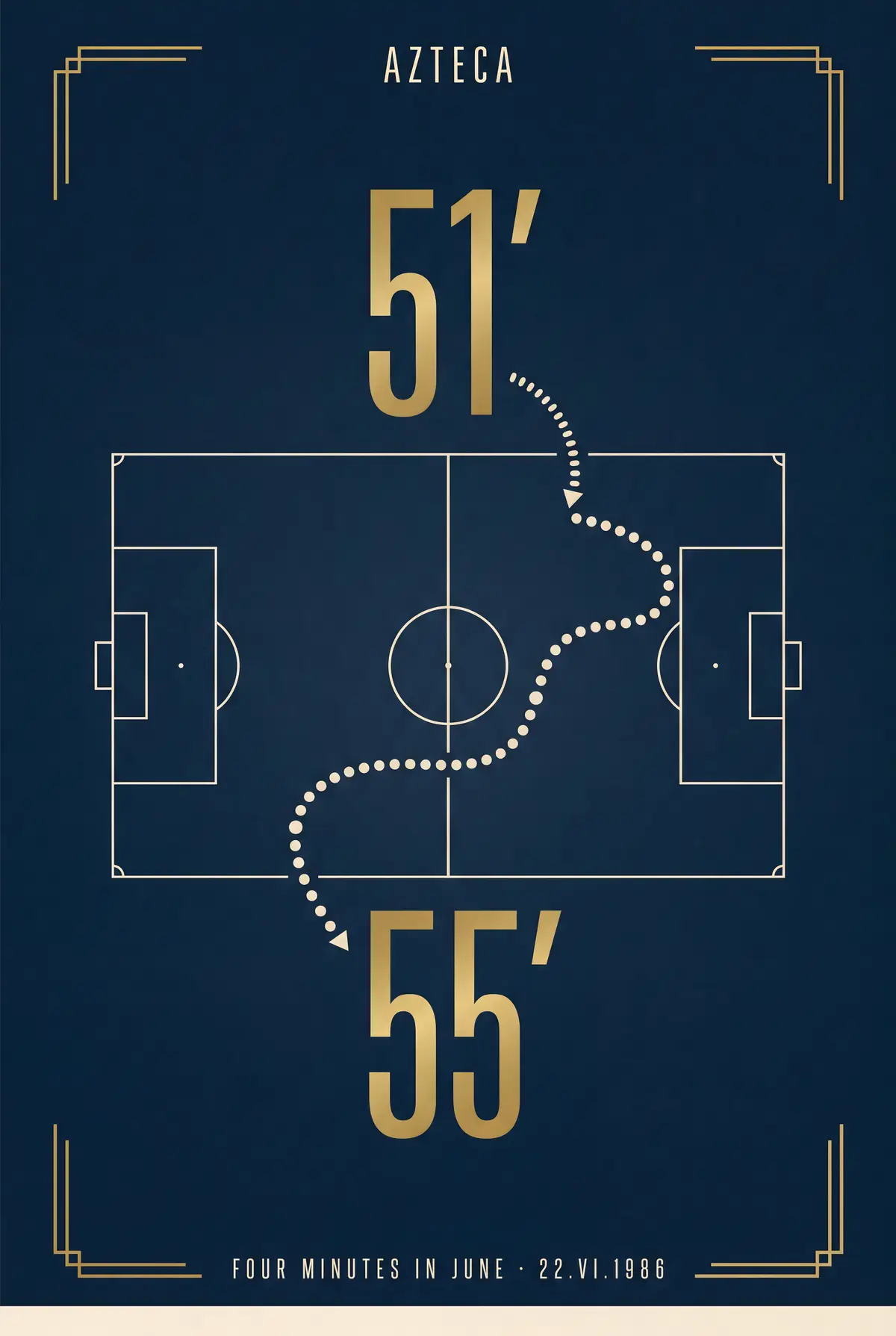
Some finals are won by the best team on the day. This one was won by the best player of the tournament, and only just. On 29 June 1986, in front of around 114,600 at the Estadio Azteca, Argentina beat West Germany 3-2, threw away a two-goal lead in the space of six minutes, then found the one pass that mattered.
The match
Argentina set the tone early. José Luis Brown, an unheralded centre-back playing the tournament of his life, headed them in front on 23 minutes from a Burruchaga free-kick, with the West German keeper Toni Schumacher caught flapping. Just after the hour Jorge Valdano made it two, racing onto a long ball and finishing low past Schumacher.
At 2-0 with half an hour left, it looked done. It was not. West Germany, managed by Franz Beckenbauer, went route one and made it count. Karl-Heinz Rummenigge bundled in from a corner on 74 minutes, and six minutes later Rudi Völler headed the equaliser from another set piece. Inside a quarter of an hour the final had been levelled, and the momentum had swung entirely.
The pass that settled it
Then Maradona, who had been man-marked and kicked all afternoon, found the one yard of space he needed. On 84 minutes he received the ball in midfield, turned, and slid a single through pass between the German defenders. Jorge Burruchaga ran onto it, held off his marker, and rolled the finish past Schumacher.
Maradona did not score in the final. He did not need to. He had carried Argentina through the tournament, and when the match was hanging level he produced the moment that decided a World Cup with one touch.
Why it mattered
This was Argentina's second world title, after 1978, and Carlos Bilardo's side were built around a simple idea: protect Maradona, give him the ball, and let him win games. He duly won the Golden Ball as the best player of the tournament.
The poster carries the line "four minutes in June", and that points to the match before this one rather than the final itself. In the quarter-final against England, also at the Azteca, Maradona scored twice in four minutes: the Hand of God, punched in and missed by the officials, and then the Goal of the Century, a run from his own half past half the England team. The two goals, the cheat and the masterpiece, sit four minutes apart and have never stopped being argued over. The final was the prize; the England game was the legend.