
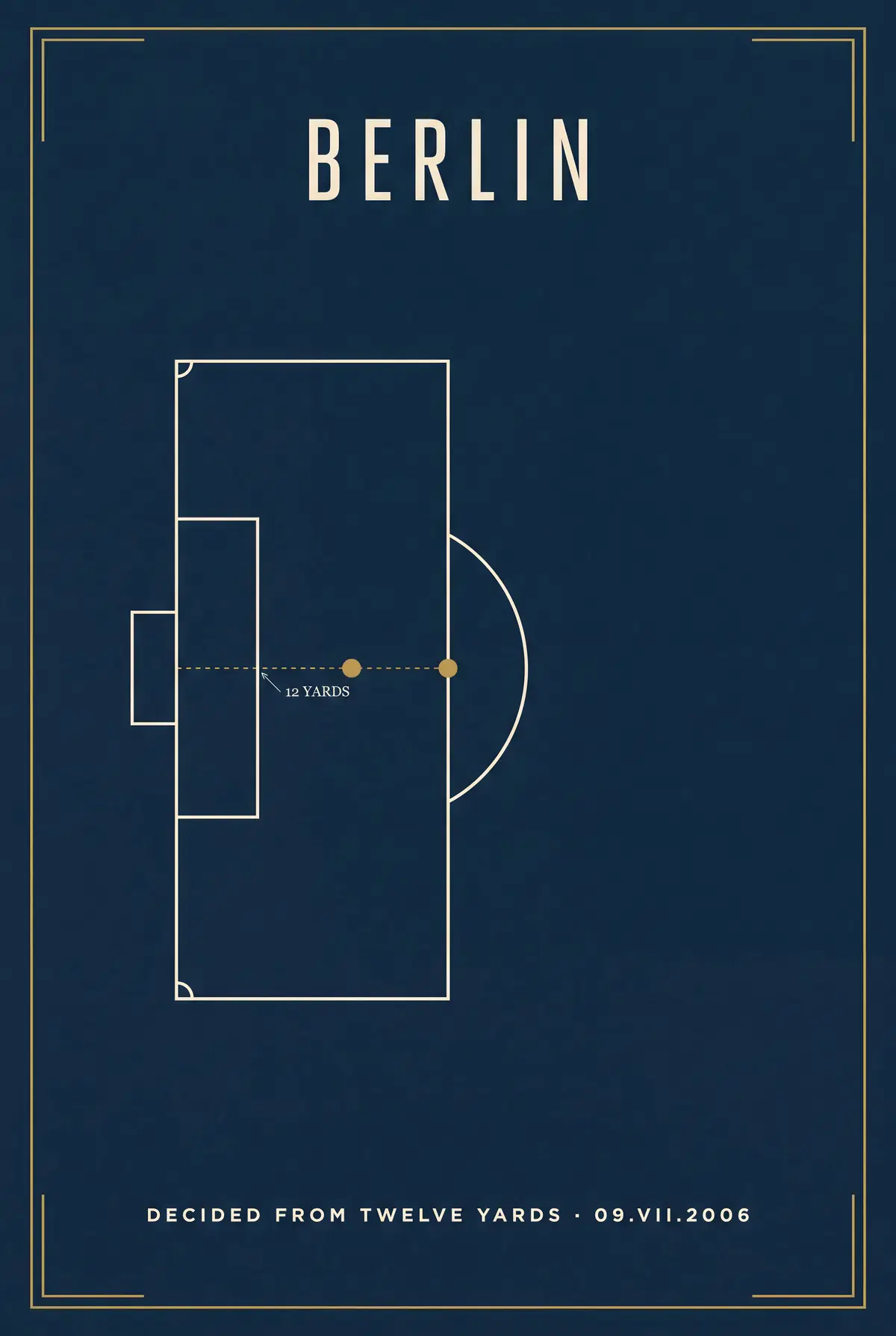
Two contradictory things are true about Berlin 2006. It was the night Italy won a fourth World Cup, and it was the night the greatest player of his generation ended his career by walking past the trophy. Both are remembered. Only one tends to be.
The match
It started at a sprint. Inside seven minutes Zinedine Zidane stepped up to a penalty and chipped it down the middle, a panenka so audacious it kissed the underside of the bar and dropped over the line. Twelve minutes later Marco Materazzi, the man who conceded the penalty, rose to an Andrea Pirlo corner and headed Italy level. After that the game settled into the careful, chess-like rhythm Italy have always played best, and it went to extra time at 1-1.
The headbutt
With the shootout approaching, the final delivered its defining image. Words were exchanged between Materazzi and Zidane. Zidane turned and drove his head into the Italian's chest, in full view of the world if not the referee, who consulted his officials and produced a red card. France's captain left the pitch for the last time, past the golden trophy he would not lift.
The shootout
Penalties suited Italy. They scored all five. France faltered when David Trezeguet struck the bar, the only miss of the night, and Fabio Grosso converted the winner to settle it 5-3. Italy had their fourth title, won the way the great Italian sides so often win finals: on nerve, not flourish.
Why it mattered
Italy won it in a summer when their domestic game was engulfed by the Calciopoli match-fixing scandal, and the squad bound itself together against the noise at home. For France it was the abrupt close of the Zidane era, a career of impossible grace ended by a moment of fury that no one has fully explained since. Few finals hold triumph and self-destruction so tightly in the same frame.